Customs vary between communities and families, so treat this as a starting point, and always ask your clients how their day ran and what matters to them.
Follow the Order of the Day
Laying out the album in sequence lets it tell the story as the family remembers it. A typical order is:
- Getting ready. The bride, the dress and the details.
- Kabbalas Panim. The bride's reception, where guests greet her, and the groom's tish, often at the same time in separate rooms. These work well facing each other across a spread.
- Badeken. The groom veils the bride. It's short and emotional, and it deserves room.
- Chuppah. The walk down, the ceremony, the rings, the blessings and the breaking of the glass. Tell it in order, across several spreads.
- Yichud. The couple's first moments alone, usually private. An image of them walking there, or coming out, can stand in for it.
- Couple portraits. These may be taken before or after the ceremony, depending on the family's customs.
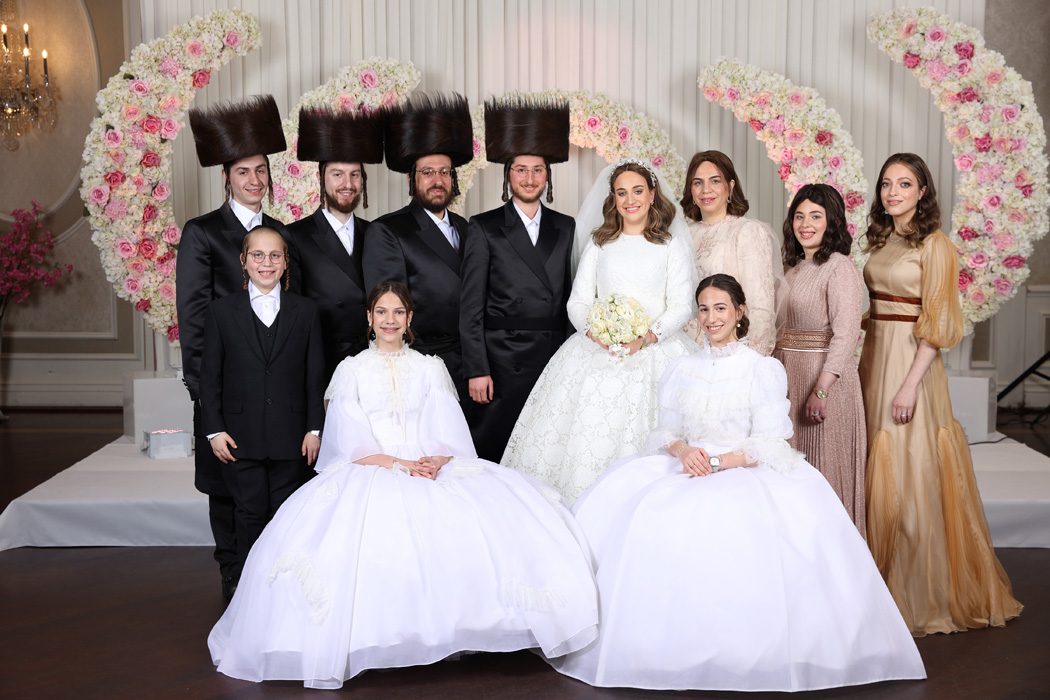
- Family portraits. Often taken between other events, with both sides of the family.
- Dancing. The energy of the hora and the lifting of the couple.
- Mitzvah Tanz. In communities that hold one, this comes late in the evening, and it's often a highlight for the family.
Plan for Large Family Groups
Large families are often the biggest layout challenge. Every face matters to the people buying the album, so:
- Give the biggest groups a full spread, so nobody is too small to recognize.
- Keep faces away from the center fold, where the pages meet.
- Group portraits by family branch, and check names and relationships with your client.
- Make sure both sides of the family get balanced space.
If a couple missed a family photo, it can often be fixed. We regularly add the bride and groom to family photos after the event.
Respect the Community's Customs
- Separate dancing. In many Orthodox and Chassidic weddings, men and women dance separately. Keep those sections on their own spreads unless your client prefers otherwise.
- Modesty. Some families have clear preferences about which images are shown, and how. Ask before you design.
- Couple images. Some couples prefer more reserved portraits, so check before using very close or romantic images.
- Hebrew text. If you add names or verses, have your client check the spelling. Remember that an album may open from the opposite side when Hebrew text is used, so confirm this before you design.
Choose How Many Spreads You Need
We recommend about 4 to 6 images per spread, so a 15-spread album holds around 60 to 90 images. Jewish weddings often have more events and larger families, so consider more spreads than a standard wedding album, and offer smaller parent albums for each side of the family.
Show the Design to the Family
Parents are often closely involved in choosing images. An online proof saves a lot of back and forth, because everyone can see the album and leave comments in one place. We use AlbumProof, our online album proofing system.
Want help with your next album?
See our Jewish wedding album design samples, or start a free trial.